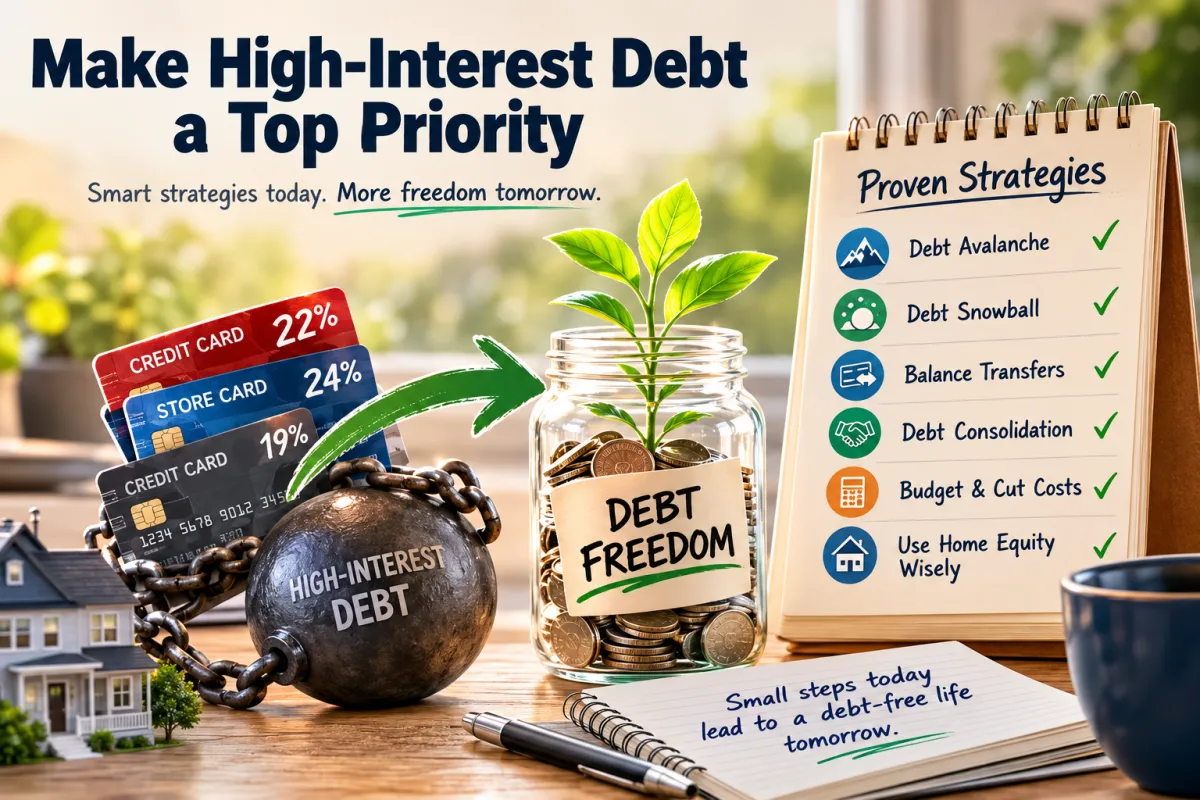
Prioritize Paying Down High-Interest Debt
Personal Finance, Debt Management, Homeowners
Why Paying Down High-Interest Debt Should Be a Top Priority
High-interest debt can erode your financial security, even if you own a home and feel generally “stable.” Understanding why this debt is so damaging, and how to tackle it strategically, can free up cash flow, reduce stress, and put you back in control of your money.
Why High-Interest Debt Is So Financially Damaging
High-interest debt, especially from credit cards, store cards, and some personal loans, works against you in three powerful ways. First, interest compounds quickly. With rates of 18–25% or more, a large portion of each payment may go toward interest rather than reducing the principal, keeping balances stubbornly high. Second, it limits your flexibility. Money that could be saved, invested, or used for home maintenance is instead locked into monthly payments. Finally, it raises your financial risk. If an emergency hits, like a job loss or major repair, high balances and minimum payments can make it harder to stay afloat.
Paying down high-interest balances is one of the most reliable “returns” you can earn. Eliminating a credit card at 22% interest is effectively like earning a guaranteed 22% on your money, year after year, with zero market risk.
Strategy 1: The Debt Avalanche Method
The debt avalanche method focuses on minimizing the total interest you pay. You list all your debts from highest interest rate to lowest. You continue paying at least the minimum on every account, but you direct every extra dollar you can toward the highest-rate debt first. Once that balance is gone, you roll its payment into the next highest rate, and so on.
This approach is mathematically efficient. Over time, you’ll usually pay less interest and become debt-free faster than with other methods, provided you stay consistent and avoid adding new balances.
Strategy 2: The Debt Snowball Method
The debt snowball method prioritizes motivation and momentum. Instead of ranking by interest rate, you list debts from smallest balance to largest. Again, you pay minimums on all, but you attack the smallest balance with every extra dollar until it’s gone. Then you move to the next smallest, rolling each freed-up payment into the next debt.
Seeing entire accounts disappear quickly can be very encouraging, which makes it easier to stay on track. While you may pay a bit more interest than with the avalanche method, many people find the psychological boost well worth it. Especially if they’ve struggled to stick with a plan before.
Strategy 3: Balance Transfer Credit Cards
A balance transfer credit card can temporarily lower your interest rate, sometimes to 0% for an introductory period. This can be a powerful tool if used carefully: more of each payment goes toward principal instead of interest, helping you make faster progress during the promo window.
However, read the fine print. Watch for transfer fees, the length of the promotional period, and the interest rate afterward. This strategy works best if you have a clear payoff plan and commit to not using the card for new spending while you’re paying down the transferred balance.
Strategy 4: Personal Loans for Debt Consolidation
Consolidating multiple high-interest debts into a single personal loan can simplify your finances and potentially lower your overall interest rate. You replace several variable, revolving balances with one fixed payment and a clear payoff date.
When evaluating a consolidation loan, compare the total cost including fees and the loan term against what you’d pay if you kept your existing debts. And as with balance transfers, commit to avoiding new credit card balances, or you may end up deeper in debt than when you started.
Strategy 5: Budgeting and Cutting Expenses
No payoff strategy works without cash to fuel it. A realistic budget helps you find money to redirect toward debt. Start by tracking your spending for a month, then identify areas to trim: dining out, subscriptions, impulse purchases, or nonessential home upgrades can often be reduced temporarily.
Consider setting a specific monthly “debt freedom” amount, an extra $100, $300, or more, that you automatically send to your chosen method (avalanche or snowball). Treat it like a required bill. Even modest cuts, sustained over time, can dramatically accelerate your progress.
Strategy 6: Using Home Equity Carefully
As a homeowner, you may have access to home equity through a home equity loan or HELOC (home equity line of credit). These products often offer lower interest rates than credit cards, which can make them attractive for consolidating high-interest debt.
However, this approach carries important risks. You’re converting unsecured debt into debt secured by your home. If you can’t make the payments, your home could be at risk. If you consider this option, run the numbers carefully, understand the terms, and make sure you’ve addressed the spending habits that led to the debt in the first place.
Moving Forward with Confidence
High-interest debt doesn’t have to be permanent. By understanding how costly it really is and choosing a payoff strategy that fits your personality and situation (avalanche, snowball, consolidation tools, or a mix) you can steadily reclaim your cash flow and peace of mind. Pair your plan with a realistic budget, protect the equity in your home, and celebrate each milestone along the way. The progress may start slowly, but with consistency, your debt will shrink, and your options will grow.